

Introduction
The word “occupation” refers to a situation in which a foreign power controls and administers a territory without the consent of the land’s legitimate sovereign authority. In international relations and law, occupations typically arise during or after armed conflict, when a state or military force takes control of another state’s territory. Though some occupations are intended to be temporary, they often evolve into long-term political and humanitarian crises, profoundly shaping the lives of those who live under foreign rule.
Definition in International Law
Under international law—particularly the Hague Regulations (1907) and the Fourth Geneva Convention (1949)—an occupation is defined as a circumstance in which a foreign military power exercises effective control over territory that does not belong to it.
Key legal principles include:
- The occupying power does not obtain sovereignty over the territory.
- It must maintain order, meet the essential needs of civilians, and uphold their rights and welfare.
- It cannot annex or make permanent political changes to the occupied land.
In reality, however, the distinction between occupation and annexation is often unclear, leading to legal disputes and diplomatic controversy in the international arena.
Historical Background
Occupations have been a recurring feature of global history—from the expansionist empires of antiquity to the wars and territorial changes of the modern era.
During World War II, for example, much of Europe fell under Nazi occupation, prompting later efforts to redefine international law to limit the legitimacy of occupation and reinforce the principles of sovereignty and self-determination after 1945.
Nonetheless, occupations have persisted into the modern day — from Western Sahara to Crimea, and most prominently, the Israeli occupation of Palestinian territories, including the West Bank and East Jerusalem (and previously Gaza). Each instance highlights the complex intersection of power, legality, and morality in regions affected by conflict.
The Israeli–Palestinian Context
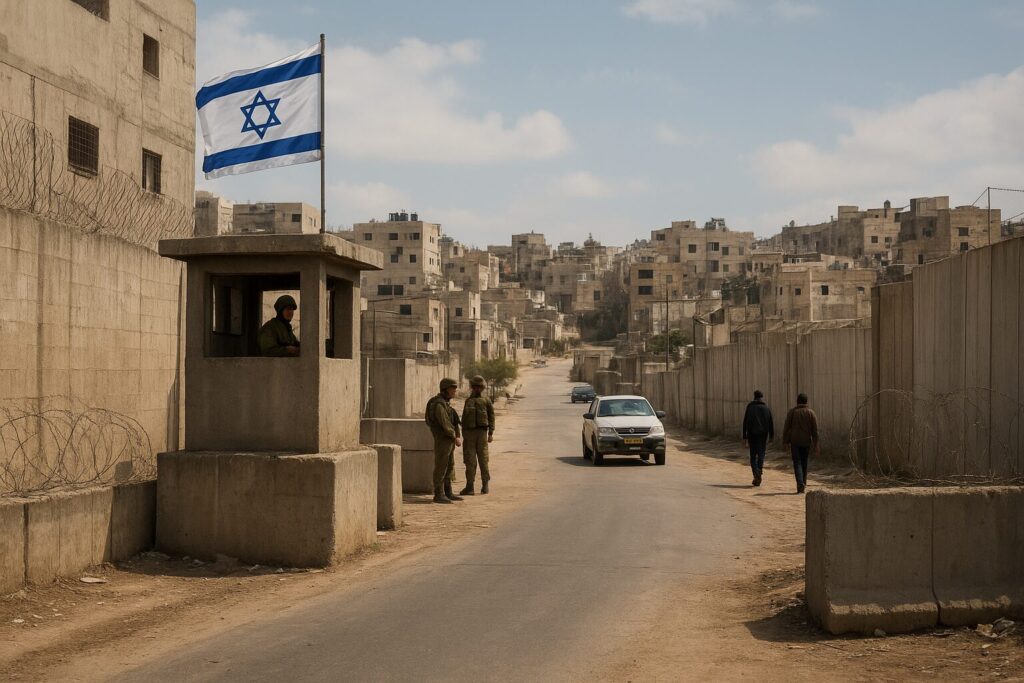
The term “occupation” is most widely associated today with Israel’s ongoing control of Palestinian territories, a situation that began following the 1967 Six-Day War.
Nature of the Occupation
- In 1967, Israel captured the West Bank, East Jerusalem, Gaza Strip, Sinai Peninsula, and Golan Heights.
- Although Sinai was later returned to Egypt (1979) and Israel withdrew from Gaza in 2005, it continues to administer and militarily control the West Bank and East Jerusalem.
- The United Nations, the International Court of Justice, and most of the international community classify this as a military occupation under international law.
Impacts of the Occupation
- Settlements: The growth of Israeli settlements across the West Bank has raised legal questions under Article 49 of the Fourth Geneva Convention, which prohibits transferring an occupier’s population into occupied land.
- Humanitarian consequences: Restrictions on movement, land access, and infrastructure severely impact the daily lives of Palestinians.
- Political stalemate: The ongoing occupation is one of the primary obstacles to achieving a two-state solution and a lasting peace agreement.
Humanitarian and Political Dimensions
Occupation reshapes every aspect of life for both the occupied population and the occupying power. It transforms economies, governance, and social structures, often leading to displacement, inequality, and unrest.
For the Occupied Population:
- Daily life is marked by checkpoints, curfews, limited access to services, and political disenfranchisement.
- The psychological and emotional toll often endures across generations, deepening resentment and despair.
For the Occupying Power:
- Long-term control over another population can result in international criticism, economic burdens, and moral challenges.
- Prolonged occupation can also undermine diplomatic relations and damage global standing.
Global Examples of Occupation
Although the Israeli–Palestinian case is the most discussed, several other examples exist around the world:
- Western Sahara: Controlled by Morocco, recognized by the UN as an occupation.
- Northern Cyprus: Under Turkish occupation since 1974.
- Crimea: Annexed by Russia in 2014; considered an illegal occupation by most of the world.
- Tibet: Seen by many as occupied by China since 1950, though China disputes this view.
These cases demonstrate that occupation is both a legal and moral dilemma, not simply a matter of military control.
Occupation and the Right to Self-Determination
The United Nations Charter and international human rights law uphold the right of all peoples to self-determination—to freely govern themselves and decide their political status.
Occupation, by its nature, denies this right, preventing local populations from exercising sovereignty or full political agency. Ending occupations typically requires negotiation, diplomacy, or international pressure, but lasting peace can only be achieved by addressing the deeper causes of conflict, including justice, equity, and historical grievances.
Conclusion
Occupation remains one of the most persistent and complex challenges in global politics. It lies at the intersection of law, morality, and power, raising profound questions about human rights, justice, and state sovereignty.
From Palestine to Crimea, the ongoing reality of occupation reminds the world that peace and security cannot thrive where people live under external control instead of self-rule. Understanding the dynamics of occupation is therefore essential to understanding the broader struggles for freedom, dignity, and lasting peace that continue to shape our world today.
