

Introduction
The West Bank is a landlocked region situated to the west of the Jordan River and east of Israel, covering roughly 5,660 square kilometers (2,185 square miles). As of 2025, its population is estimated at around 4.2 million people. The territory holds immense significance in the historical, political, humanitarian, and cultural landscape of the Middle East, making it one of the most closely watched regions in global affairs.
Historical & Geographical Overview
The name “West Bank” refers to its location along the western side of the Jordan River. Historically, it was part of the British Mandate of Palestine until 1948. Following the Arab–Israeli War of 1948, the territory came under Jordanian rule and was officially annexed by Jordan in 1950.
During the Six-Day War of 1967, Israel seized control of the West Bank, maintaining a military occupation that continues to this day. The issue of East Jerusalem adds further political and legal complexity to the region’s status.
Geographically, the West Bank’s terrain varies widely — mountainous highlands such as the Judean and Samarian Hills dominate the west, while the land gradually slopes eastward toward the Jordan Valley and the Dead Sea.
Political & Administrative Structure
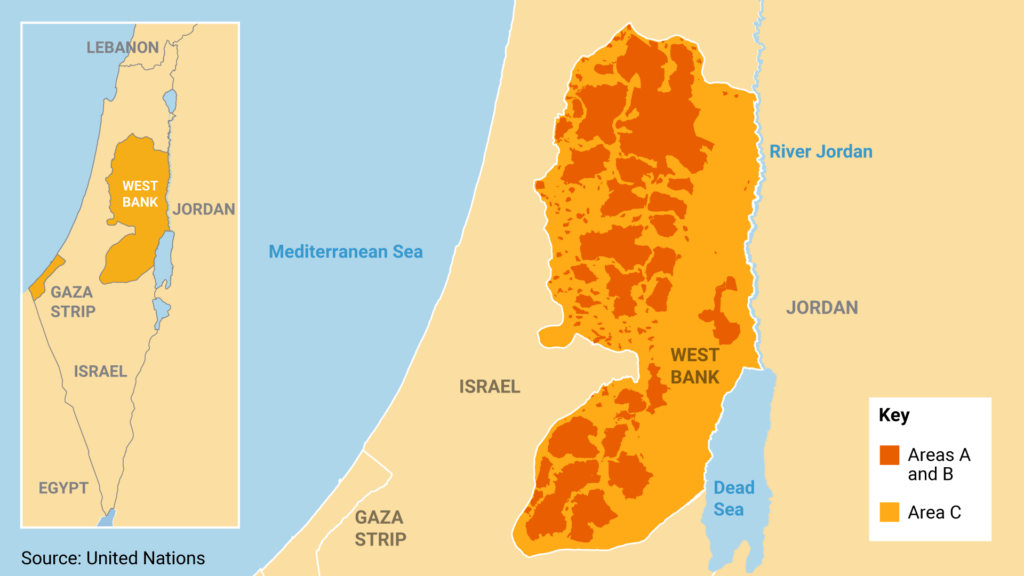
Following the Oslo Accords of the 1990s, the West Bank was divided into three administrative zones reflecting different levels of control:
- Area A: Full civil and security control by the Palestinian Authority (PA).
- Area B: Civil control by the PA, but security control by Israel.
- Area C: Complete Israeli civil and security control, covering nearly 60% of the West Bank’s total area.
Across the region, Israeli settlements and outposts have expanded steadily, becoming one of the central sources of tension in the conflict. The majority of the international community considers these settlements illegal under international law, though this remains a contested issue.
Humanitarian, Economic & Social Conditions
The West Bank’s economy faces deep structural challenges, including scarce natural resources, restrictions on movement and trade, and a heavy reliance on international assistance. Infrastructure development is often limited by political and security constraints.
According to CIA data, the region’s GDP per capita stands at approximately $5,600, reflecting the economic difficulties faced by many residents. The majority of the population is Palestinian, while hundreds of thousands of Israeli settlers live across various settlements.
Daily life in the West Bank is shaped by restrictions on water access, agriculture, housing, and freedom of movement, all of which are closely tied to the ongoing political situation and military control.
Why the West Bank Matters
For Palestinians, the West Bank is at the heart of their national identity and central to their aspirations for an independent state. Its future is essential to any feasible two-state solution.
For Israel, the region carries major security, strategic, and religious significance, particularly regarding areas historically known as Judea and Samaria.
On the global stage, the West Bank remains a focal point for debates over international law, human rights, diplomacy, and peace efforts. How the situation evolves — from settlement expansion to governance and negotiations — will play a defining role in shaping the future of Middle Eastern stability.
Current Challenges & Key Flashpoints
- Settlements and Land Disputes: Ongoing settlement construction continues to escalate tensions and threatens the territorial unity of a potential Palestinian state.
- Mobility and Access: Checkpoints, barriers, and the fragmented Area A/B/C divisions severely restrict Palestinian movement and economic growth.
- Governance Issues: Political fragmentation between Palestinian factions, combined with Israeli control and stalled peace talks, leave the West Bank in a state of political paralysis.
- Economic and Infrastructure Barriers: Investment and development remain hampered by instability, limited sovereignty, and dependence on foreign aid.
- Human Rights and Legal Concerns: Issues such as home demolitions, settler-related violence, and land confiscation continue to raise questions under international law and humanitarian standards.
Conclusion
The West Bank is a region shaped by centuries of history, enduring conflict, and unwavering resilience. Beyond its geopolitical symbolism, it is home to millions whose daily lives are influenced by the ongoing struggle for freedom, security, and identity.
Understanding the West Bank requires a deep look into its geography, people, governance, and the broader questions of justice, peace, and coexistence it represents. The region’s future will continue to influence not only Israeli–Palestinian relations but also the stability and moral conscience of the wider world.
